+61 468 126 464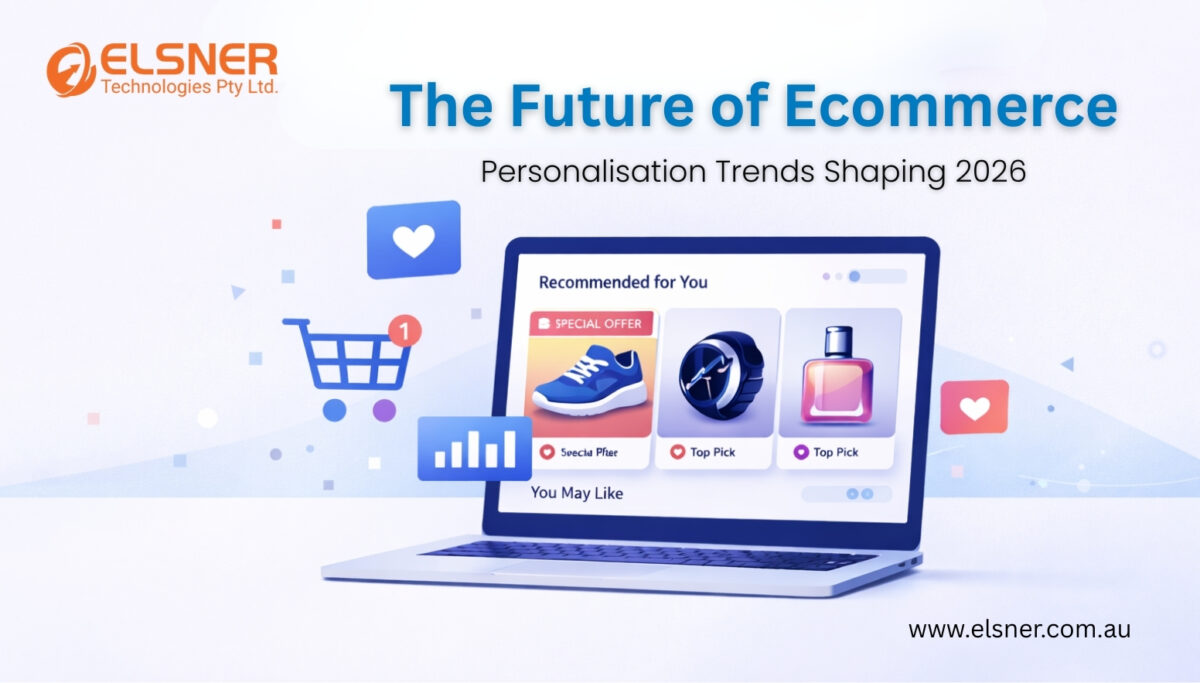

The Future of Ecommerce: Personalisation Trends Shaping 2026
E-CommerceEcommerce used to mean simply having an online store with reasonably priced products. However, by 2026, success in digital retail will hinge on how deep brands’ understanding of individual customer needs is and how quickly they respond to those needs.
The industry is an example of how ecommerce personalisation trends are revolutionising how business is done. Simply put, ecommerce personalisation is a business practice in which a customer receives a shopping experience tailored to their behaviour, preferences, location, and purpose.
Australian consumers are increasingly selective. They not only want online stores to recognise them, remember their likes and dislikes, but also to present them with relevant products without being intrusive. Suddenly, amid fierce competition and skyrocketing customer acquisition costs, generic storefronts are no longer the go-to for grocers seeking to survive. In the following year, ecommerce personalisation 2026 will no longer revolve around the mere act of product promotion but more on the establishment of meaningful, data-driven relationships.
What’s New for Ecommerce Trends?
What was once a far-fetched personalisation idea is now a reality, driven by advances in AI, analytics, and real-time data processing. Be it savvy product recommendations, varied content, or customised support, the use of technology in the brand-customer relationship is a winning move for both parties. Meanwhile, changes in consumer expectations prompt businesses to drop the “one-size-fits-all” marketing stance and embrace personalisation.
This article presents the personalisation revolution as the main theme of the future of ecommerce, outlines 2026 trends, and offers practical, actionable points to help businesses stay ahead in a digitally evolving landscape.
Understanding Ecommerce Personalisation
Ecommerce personalisation is the practice of presenting targeted content, product recommendations, and offers to individual shoppers based on their data and actions. Instead of showing the same home page to every visitor, personalised ecommerce adjusts instantly. For instance, it could be promoting items based on browsing history, showing personalised landing pages, or offering tailored discounts to returning customers.
A truly personalised shopping experience focuses on seamless interaction. Hence, it links every interaction into a single continuous flow. For instance, a customer who searches for running shoes on their mobile phone can receive relevant email suggestions later, or, when revisiting the website, see matching accessories. This is the aspect where customer journey personalisation becomes indispensable.
The benefits of personalisation are well-documented. Retailers enjoy higher engagement, better conversion rates, higher average order value, and deeper customer loyalty. Additionally, personalised experiences eliminate friction, making the shopping process more attractive and easier. As competition intensifies, brands that invest in well-thought-out personalisation in online shopping are more likely to retain customers than continually seek new ones.
In 2026, personalisation should no longer be seen as an additional feature “that would be nice to have”. On the contrary, it should be viewed as a fundamental strategy that significantly shapes how customers perceive and interact with ecommerce brands.
Why Personalisation Is Critical in 2026?
The way shoppers behave has changed drastically. Today, customers expect brands to anticipate not only their needs but also the right solutions at the right moment. As a result, if an online store fails to stay relevant, users are quick to abandon it. This is why the emergence of AI ecommerce personalisation has become a decisive competitive factor rather than just an optional technological upgrade. For businesses investing in ecommerce website development Sydney, integrating AI-driven personalisation is no longer about standing out—it’s about meeting modern customer expectations and staying ahead in an increasingly crowded digital marketplace.
Constantly personalised experiences are at the core of research investment strategies and thus deliver strong returns. Current businesses that implement proper personalisation show in their reports enhanced conversion rates, increased customer lifetime value, and increased brand loyalty. In the Australian ecommerce market, where competition is fierce, personalisation is the key factor that differentiates growth from stagnation.
Another reason personalisation is essential is the complexity of the customer journey. Buyers experience brand offerings through not just websites but also mobile apps, social media, and emails. At the same time, without a consolidated strategy for customer journey personalisation, the service provided will be disunited and lead to dissatisfaction. The benefit of personalisation is that it creates a platform where customers feel understood and appreciated, and are more confident in their purchasing decisions.
By 2026, clients will view personalisation as the norm in service delivery. Consequently, companies that are reluctant to adopt this strategy may be seen as behind the times, cold, and unaware of their audience’s needs.
Top Ecommerce Personalisation Trends in 2026
AI-Driven Product Recommendations
The massive shift in ecommerce personalisation trends toward AI-driven product recommendations is essentially the change to AI-driven product recommendations. AI can consider factors such as browsing behaviour, purchase history, and real-time signals to generate a list of products a purchaser is most likely to buy. This concept of AI ecommerce personalisation is widely regarded as one of the most influential principles of 202,6, as it fosters greater trust and is less intrusive.
Hyper-Personalised Email Campaigns
If used properly, email remains a powerful channel. In the case of ecommerce personalisation 2026, the emails are totally different from the old ones as they are dynamically adjusted depending on the user’s browsing behaviour, the shopping cart left behind, and previous purchases; hence, the customers receive a real personalised shopping experience that is capable of driving the engagement rates up.
Personalised Web and Landing Pages
Current ecommerce solutions offer features that allow businesses to tailor content based on user behaviour, device type, and location. Companies using ecommerce personalisation strategies 2026 have already begun investing in dynamic homepages, banners, and offers that align with individual intent. Understanding how to personalise ecommerce website experiences is now a core skill for digital teams.
Omnichannel Personalisation
Customers expect consistency across all touchpoints. Omnichannel personalisation ensures seamless experiences across web, mobile, social media and email. This unified approach strengthens customer journey personalisation and reduces friction throughout the purchasing process.
Voice and Visual Commerce Personalisation
Voice search, visual search, and AR-based shopping are gaining momentum. These technologies represent the future of ecommerce personalisation, allowing shoppers to interact with products in more natural and engaging ways. Combined with AI-powered ecommerce personalisation, these tools improve discovery and trust.
Personalised Loyalty Programs and Offers
In 2026, loyalty programs will be turning more intelligent. Instead of fixed rewards, brands use predictive insights to offer personalised incentives that encourage repeat purchases and long-term engagement.
AI Chatbots and Personalised Support
Customer support is also becoming more personalised. AI chatbots provide real-time, context-sensitive assistance that improves satisfaction and reduces operational costs. These tools play a key role in delivering consistent ecommerce personalisation trends across the entire customer journey.
How to Use Personalisation to Enhance Your Ecommerce Store
The successful execution of personalisation needs a well-planned strategic approach. The first step is data analysis, where one gets acquainted with customer behaviour, preferences, and pain points. Customer journey mapping is a great help in identifying which personalisation touchpoints deliver the most results.
Furthermore, audience segmentation is really vital. Not all customers behave the same, and personalisation should account for these distinctions. AI software integration automates, scales, and improves accuracy. Maintaining regular testing while optimising results is the key to sustaining the long-term success of strategies.
Brands looking to implement ecommerce personalisation strategies in 2026 should focus on building flexible systems that evolve with customer expectations rather than relying on rigid rules.
The Ups and Downs of Personalisation
While personalised solutions offer advantages, they also carry a few downsides. Data privacy concerns are at the centre of attention among Australian consumers lately. Being transparent, seeking consent, and complying with the rules are must-haves if one is to maintain trust.
Many businesses struggle to integrate different platforms because they do not integrate well. Adopting platform-agnostic solutions and focusing on user experience helps overcome these obstacles while strengthening customer journey personalisation.
Future Outlook Beyond 2026
By envisioning the future, one can expect personalisation to become far more predictive and immersive. The next stage will be characterised by hyper-personalised omnichannel experiences, AI-driven prediction of customer needs, and shopping environments powered by AR. top eCommerce website designers Sydney will combine cutting-edge technology with the human touch, creating experiences that feel both natural and valuable.
How Elsner Helps Brands Succeed
As ecommerce transitions to experience-led growth, Elsner Technologies helps brands establish data-driven, customer-centric relationships. Thoroughly acquainted with ecommerce personalisation trends, Elsner not only strategises but also executes AI-powered personalisation tactics that are technically feasible, modular, and aligned with business goals. The idea is not to use a one-size-fits-all solution, but to tailor the customer experience so it feels like a natural flow and addresses each consumer’s specific needs.
Local ecommerce businesses receive real help from Elsner through the complete mapping and optimisation of a customer’s digital shopping journey. From the first brand visit through to a post-sale brand-customer dialogue, the entire interaction process is revamped, with brand consistency and customer relevance as the main deliverables. This approach ensures brands are fully prepared for ecommerce personalisation 2026, where customer expectations are higher than ever.
What makes Elsner so different is the predominant focus on the source of that data and the realisable outcomes that follow. The achievement of set personalisation goals is evident in the quantitative data for their respective KPIs, such as engagement, conversions, and customer retention. For brands planning long-term growth, Elsner provides a strong foundation aligned with the future of ecommerce personalisation. Get in touch with Elsner today to start transforming your ecommerce strategy with data-driven personalisation.
Frequently Asked Questions
1. What is ecommerce personalisation?
Content, recommendations, and offers presented to a single shopper based on their behaviour and preferences constitute ecommerce personalisation.
2. Why is personalisation important for online stores in 2026?
By doing so, ecommerce businesses gain three things simultaneously: customer engagement, conversions, and loyalty. All these are achieved through the provision of relevant experiences, which, in turn, lead to customer satisfaction.
3. How can AI improve ecommerce personalisation?
Introducing AI into the system enables the implementation of the following functions: predictive recommendations, automated content creation, and personalised customer support at scale.
4. What are the main challenges in ecommerce personalisation?
These are primarily issues related to data privacy, system integration, and uncompromising user experience.
5. How do I implement a successful personalisation strategy?
Your initial step should be to conduct data analysis, then create a customer journey map, segment your audience, leverage AI, and continually refine your plans.
6. What are the future trends in ecommerce personalisation?
AR/VR shopping, AI-powered predictions of customer engagement, and extremely personalised omnichannel journeys, supported by a well-defined 2026 ecommerce personalisation roadmap, may be emerging trends in this field.