+61 420 222 417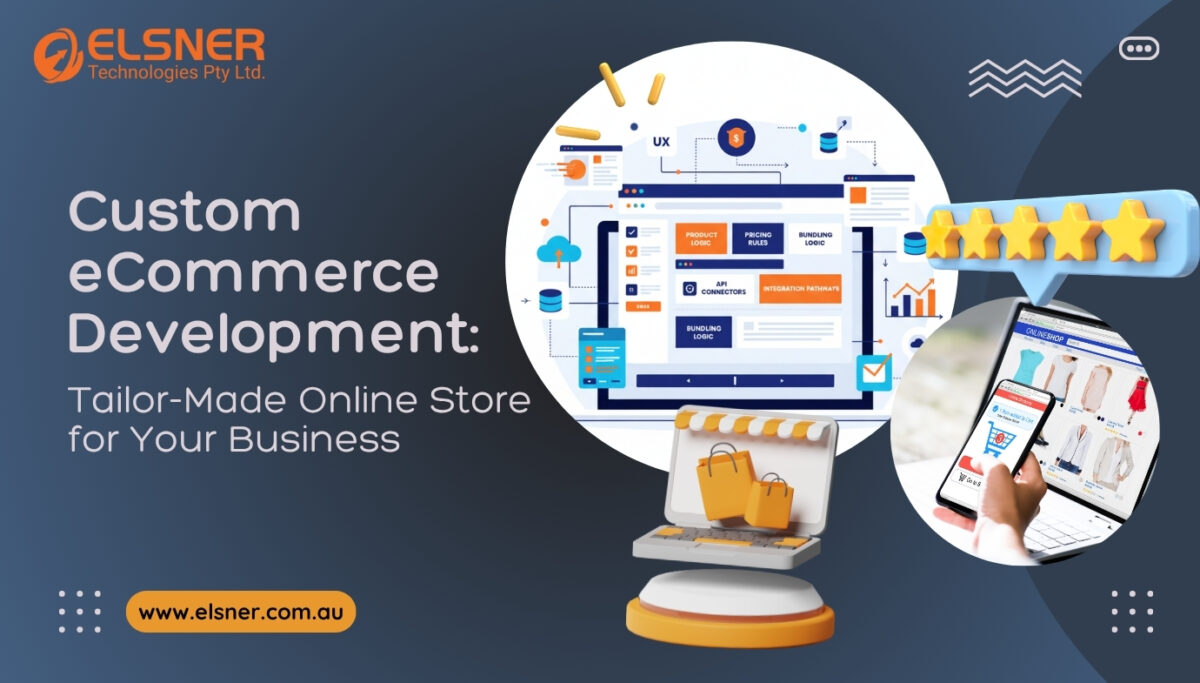

Custom eCommerce Development: Build a Tailor-Made Online Store for Your Business
E-Commerce, Web DesignThe true commerce advantage in Australia isn’t “being online”; it’s in building a commercial engine that non-commodity competitors can’t neutralise — a principle reinforced in Shopify’s latest eCommerce strategy insights.
And that is why custom ecommerce development exists. It is not “fancy code”. It is designing software based on how your business monetises. Most companies do not step back and realise this: commerce platforms have an opinion on how your business should work. Shopify has an opinion. WooCommerce has an opinion. Magento has an opinion. Every template ecosystem has edges.
Those edges become ceilings. So, a business that is actually trying to scale hits a wall.
That wall is always the same:
We can no longer make the generic platform behave like our business.
That is the structural reason advanced Australian retail brands, wholesale distributors, hybrid B2B/B2C companies, and evolving subscription businesses move to custom online store development.
It is not ego, nor is it luxury. It’s building a real digital commercial asset.
When you choose bespoke ecommerce solutions, you are choosing an architecture whose functionality is not constrained by plugins, something clearly outlined in Microsoft’s microservices architecture principles.
- An architecture whose functionality is not constrained by plugins.
- a business model that is not forced into a template
- A UX unlike that of any other store on the internet.
That is why custom continues to rise — because the “platform-first” decade is ending, and the “commercial capability” decade has begun.
Why Businesses Need Custom Ecommerce Development?
Unique Branding and Design
In Australia, customers can almost smell “template” store UX from the first scroll.
Brand is not only about colour and logo. Brand is how a store behaves.
If your product finder behaves differently, customers perceive the brand differently. If your tiered pricing follows a specific pattern, customers perceive value differently. If your delivery promise is modelled in a personalised logic, customers perceive reliability differently.
That is what template stores cannot deliver: they are designed to provide generic conversion, not branded behaviour.
Scalability and Performance
Every business thinks that scaling problems are “tomorrow’s problems” – until the day that tomorrow becomes today.
Scaling doesn’t mean “turn on more cloud compute”. Scaling means scaling the model.
When Black Friday spikes load by 7X and you have conditional promotions, conditional pickups, dynamic personalised merchandising, and complex product bundles, performance breaks.
That’s why growth-mode companies move to bespoke ecommerce solutions: they want to choose how caching works, how infrastructure is sharded, and how traffic is routed to microservices.
This is proper commercial digital engineering.
Advanced Functionality
This is the true pivot point. Some business models literally cannot be executed inside an app store mentality.
Examples:
- A nutrition company has bundled logic that dynamically changes the prices of its contents based on dietary exclusions.
- A B2B industrial supplier with conditional quoting rules based on buyer type + contract status, + geography.
- A manufacturer of furniture with 3D product builder logic.
Try forcing those into a plugin ecosystem.
This is retailer-made ecommerce that earns every cent.
Integration with Third-Party Systems
Integration is not “connect this ERP”. Integration means designing the data contract between systems.
It defines:
- What emits events
- What subscribes to events
- How errors are handled
- How does asynchronous reconciliation occur?
- Where truth is kept
This is the core labour of ecommerce software development — not templates, not page builders.
It is the infrastructure layer — the invisible layer — that dictates whether you’re a website or whether you’re an operating system.
Custom eCommerce Development Process
Requirement Analysis
This is where all the commercial risk is neutralised.
Bad builds always come from bad requirements. Great builds always come from deep requirement discipline.
The following includes what proper requirement analysis encompasses:
- commercial model mapping
- SKU modeling
- engine logic offering
- discount logic
- return/refund logic
- factoring in Australian tax and GST logic
- operational / pick pack flows
- customer tier structures
- finance reporting requirements
- customer segmentation models
- channel conflict/channel strategy
- mobile-first buyer journey analysis
Design and Prototyping
Design is not “the visual UI”. Design is the decision about how users think on a page.
For brands looking to strengthen their understanding of what truly drives high-performing eCommerce design, this Ultimate Guide to eCommerce Website Design offers a clear, practical foundation.
Prototyping allows for:
- cognitive friction testing
- drop-off prediction
- scroll heat mapping
- Measurement of the completion of a task
- decision tree compression
Development
That’s where custom online store development becomes an actual piece of software.
Commercial complexity is mapped to code structure.
The code base becomes the “truth” of your operating model.
Testing and QA
Proper engineers understand this: tests are the prototype product.
Testing isn’t a final phase. Testing is a parallel discipline.
This includes:
- unit testing every branch of logic
- Integration testing of each data contract
- performance testing under future load assumptions
- regression testing for every deploy
- security testing for threat models, not checklists
Deployment and Launch
Launch is not a “moment.” Launch is a controlled orchestration.
This includes:
- data migration
- DNS cutover
- rollback protocols
- smoke tests
- final merchant ops training
- The final live payment test transactions
Post-Launch Support and Maintenance
Every great eCommerce platform is evolving continually. If you stop evolving, your model decays. Maintenance is where commercial winners emerge.
Technologies Used in Custom E-commerce Development
The Australian custom commerce market is usually modern-stack-weighted.
Common patterns:
Frontend
- React → for component logic and speed
- Vue → for compatibility with smaller team scaling
- Angular → for enterprise, especially if there is already Angular in the business.
Backend
- Node → for micro-service composable builds
- Laravel → for structured monoliths
- Django → for large data model control
Database
- Postgres → when relational modelling is strong
- Mongo, when the products are flexible, attribute-rich
- MySQL → when there is legacy interop
There will also always be:
- orchestration layers
- queue systems
- API gateway layers
- observability tooling
- feature flags
- analytics pipelines
This is what real ecommerce website development looks like when you aren’t constrained within a plugin marketplace.
Benefits of Choosing Custom Ecommerce Development
This is the clearest way to articulate the benefit:
Template eCommerce is about getting online. And custom ecommerce is about commercial operating leverage.
Which means:
- You can price differently from competitors
- You can merchandise differently.
- You can fulfil differently
- You can personalise at the model level
Most importantly, you can materialise your commercial strategy INTO software.
That is why:
- Custom ecommerce development is not developer-driven; it is business model-driven.
- Tailor-made ecommerce has become a serious path to disciplined commercial growth for brands on the move.
- Custom online store development returns ROI in the real world, not just in vanity metrics.
Common Challenges and How to Overcome Them
Here is the truth:
Custom scares people.
You are building your own IP, your future constraints, your own freedom. So if you don’t have a senior partner, it can go wrong.
This is a point at which Elsner Technologies is extremely well aligned with Australian brands.
- They understand commercial modelling.
- They plan phases of requirements appropriately.
- They make integration an engineering discipline.
- They don’t abandon after launch.
- They run maintainable code bases.
They are not a “web shop”.
They are an ecommerce software development organisation.
They solve the three anxieties of custom development:
- “Will this be completed in time?”
- “Will this be cost-friendly?”
- “Will this be maintainable?
That is why Elsner is a real commercial partner, not a freelancer on a marketplace.
Conclusion
If you want a generic store, use a generic platform. Invest in bespoke ecommerce solutions if you’re looking for a durable commercial differentiator.
Suppose you want a digital product that behaves precisely the way your business makes money. In that case, the only rational long-term strategic path is custom ecommerce development guided by a serious engineering partner.
Elsner Technologies is one of the few in Australia that can actually implement it right, at the level where quality really matters, over a multi-year period, not just at launch.
Ready to Scale Your Ecommerce Store?
👉 Partner with Elsner Technologies and build an ecommerce platform that becomes your competitive advantage.
FAQs
1. What is custom ecommerce development?
It’s about building software capability around your commercial model, rather than forcing your model into a pre-made tool.
2. How much does a custom online store cost?
Cost is based on functionality, integration complexity, data model complexity and governance maturity.
3. How long does it take to develop a custom ecommerce website?
Mid-complexity builds are measured in months — not weeks.
4. Can I integrate my existing systems with a custom ecommerce store?
Yes, that is one of the strongest reasons to go custom, so that systems behave like one single operational organisation.